
Context
Wombat's multi-provider Terraform coverage includes Hetzner Cloud alongside AWS, Azure, GCP, STACKIT and OVHcloud (framework v1.1.0).
Assess Hetzner Cloud workloads with the same provider-neutral controls, with a focus on cost efficiency, reliability and European residency.
Hetzner Cloud is a European provider with framework control coverage in the current control pack. Use the neutral baseline to compare cost, reliability and sovereignty without maintaining a separate assessment.
The current framework control pack includes 72 controls with Hetzner Cloud-specific checks.
Wombat's multi-provider Terraform coverage includes Hetzner Cloud alongside AWS, Azure, GCP, STACKIT and OVHcloud (framework v1.1.0).
Use the sovereignty hub to connect provider choice to residency, key ownership and exit.
The cost and reliability pillars are the natural starting points for a Hetzner workload review.
Start with the Hetzner Cloud provider and keep cost, reliability and residency in the same review.
terraform {
  required_version = ">= 1.6.0"
  required_providers {
    hcloud = {
      source  = "hetznercloud/hcloud"
      version = "~> 1.0"
    }
  }
}

provider "hcloud" {}
wombat check . --output jsonUse the standard HCLOUD_TOKEN environment variable. Keep the token out of Terraform state and source control.
Approximate locations only. The dashboard maps 20 region codes for this provider; below are the distinct locations in that map.
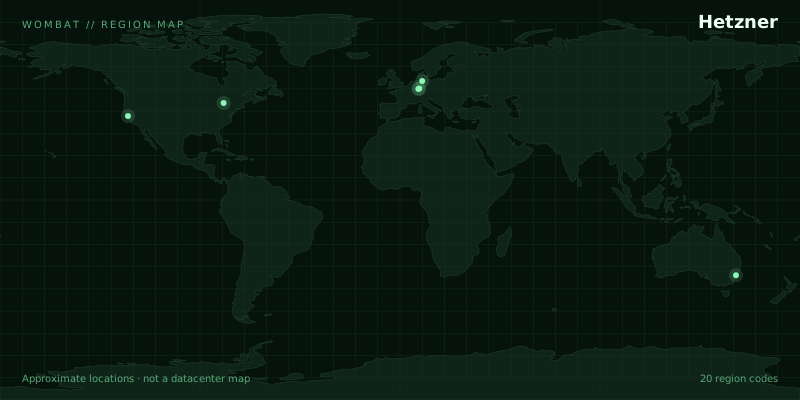
Approximate region locations from the dashboard map. Not a datacenter map.
Data status. The region labels for Hetzner Cloud are compiled from the WOMBATpass dashboard region map. The current extract is dated 31 Oct 2026. The page currently lists 20 region codes from that map.
Verification. The data has not been cross-validated with the provider. It may be incomplete, approximate or outdated.
Intended use. The information is provided for general orientation only. It is not a guarantee of service availability, a representation of exact datacenter locations, or a statement of provider certification.
Corrections. Providers and other parties may submit corrections — including the provider name, the affected region code or control count, and a public source — to page@wombat-gov.dev or open a correction issue ↗.
Trademarks. Provider names and trademarks are the property of their respective owners. Wombat is not affiliated with, endorsed by or sponsored by these providers; the names are used solely for identification.
License. The provider data on this page is published under CC BY 4.0. It is a derived compilation from the WOMBATpass dashboard and the Wombat framework control pack. Attribution: Wombat Community. The data is provided without warranty. Data license.
Methodology. Read the data methodology →
The same control model applies across providers, so the comparison stays consistent when the estate does not.
European residency, key custody and exit are central to the provider choice.
Read the Sovereign pillar →Hetzner is often chosen for cost efficiency; the score should keep that honest against reliability.
Read the Cost Optimization pillar →Identity, network isolation and encryption still determine the security baseline.
Read the Security pillar →Backup, recovery and portability determine whether the cost advantage is durable.
Read the Reliability pillar →Unique controls with provider-specific checks in the current framework control pack. A control may have multiple checks.
Snapshot of the current framework control pack; counts are not a certification. See the full coverage table →
Use the provider-native guidance for depth, and the Wombat baseline for the cross-provider score, comparison and evidence.
Score the Hetzner workload against the same neutral baseline, then use the cost and sovereignty views to make the trade-off explicit.