
Context
Wombat's multi-provider Terraform coverage includes AWS alongside Azure, GCP, STACKIT, OVHcloud and Hetzner Cloud (framework v1.1.0).
Use AWS Well-Architected as the provider-native lens, then add the cross-provider sovereignty, evidence and cost controls that a multi-cloud estate needs.
AWS gives teams a strong opinionated framework. Wombat does not replace it. It adds a provider-neutral baseline so the same workload can be assessed consistently when it also touches Azure, GCP, STACKIT, OVHcloud or Hetzner Cloud.
The current framework control pack includes 94 controls with AWS-specific checks.
Wombat's multi-provider Terraform coverage includes AWS alongside Azure, GCP, STACKIT, OVHcloud and Hetzner Cloud (framework v1.1.0).
Use the comparison page to see where AWS Well-Architected and Wombat overlap, and where Wombat adds sovereignty and evidence coverage.
The scorecard and CI action work with the same control model you use on the other providers.
Start with a pinned AWS provider, then run the same control pack you use on the other providers.
terraform {
  required_version = ">= 1.6.0"
  required_providers {
    aws = {
      source  = "hashicorp/aws"
      version = "~> 5.40"
    }
  }
}

provider "aws" {
  region = "eu-central-1"
}
wombat check . --output jsonSet AWS credentials through the standard AWS environment variables or profile. Pin the provider version to the one approved in your platform.
Approximate locations only. The dashboard maps 35 region codes for this provider; below are the distinct locations in that map.
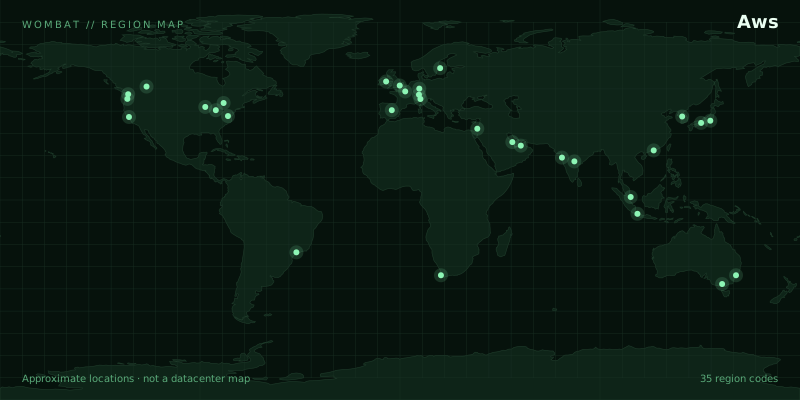
Approximate region locations from the dashboard map. Not a datacenter map.
Data status. The region labels for AWS are compiled from the WOMBATpass dashboard region map. The current extract is dated 31 Oct 2026. The page currently lists 35 region codes from that map.
Verification. The data has not been cross-validated with the provider. It may be incomplete, approximate or outdated.
Intended use. The information is provided for general orientation only. It is not a guarantee of service availability, a representation of exact datacenter locations, or a statement of provider certification.
Corrections. Providers and other parties may submit corrections — including the provider name, the affected region code or control count, and a public source — to page@wombat-gov.dev or open a correction issue ↗.
Trademarks. Provider names and trademarks are the property of their respective owners. Wombat is not affiliated with, endorsed by or sponsored by these providers; the names are used solely for identification.
License. The provider data on this page is published under CC BY 4.0. It is a derived compilation from the WOMBATpass dashboard and the Wombat framework control pack. Attribution: Wombat Community. The data is provided without warranty. Data license.
Methodology. Read the data methodology →
The same control model applies across providers, so the comparison stays consistent when the estate does not.
Identity, network boundaries, encryption and vulnerability handling are the first review surface.
Read the Security pillar →Commitments, waste and unit economics need a consistent baseline across accounts.
Read the Cost Optimization pillar →Multi-AZ, backup and recovery decisions should be scored, not assumed.
Read the Reliability pillar →Region choice, key custody and exit paths matter even on a mature provider.
Read the Sovereign pillar →Unique controls with provider-specific checks in the current framework control pack. A control may have multiple checks.
Snapshot of the current framework control pack; counts are not a certification. See the full coverage table →
Use the provider-native guidance for depth, and the Wombat baseline for the cross-provider score, comparison and evidence.
Keep the provider-native review, then use the Wombat score to compare the same workload across providers and over time.